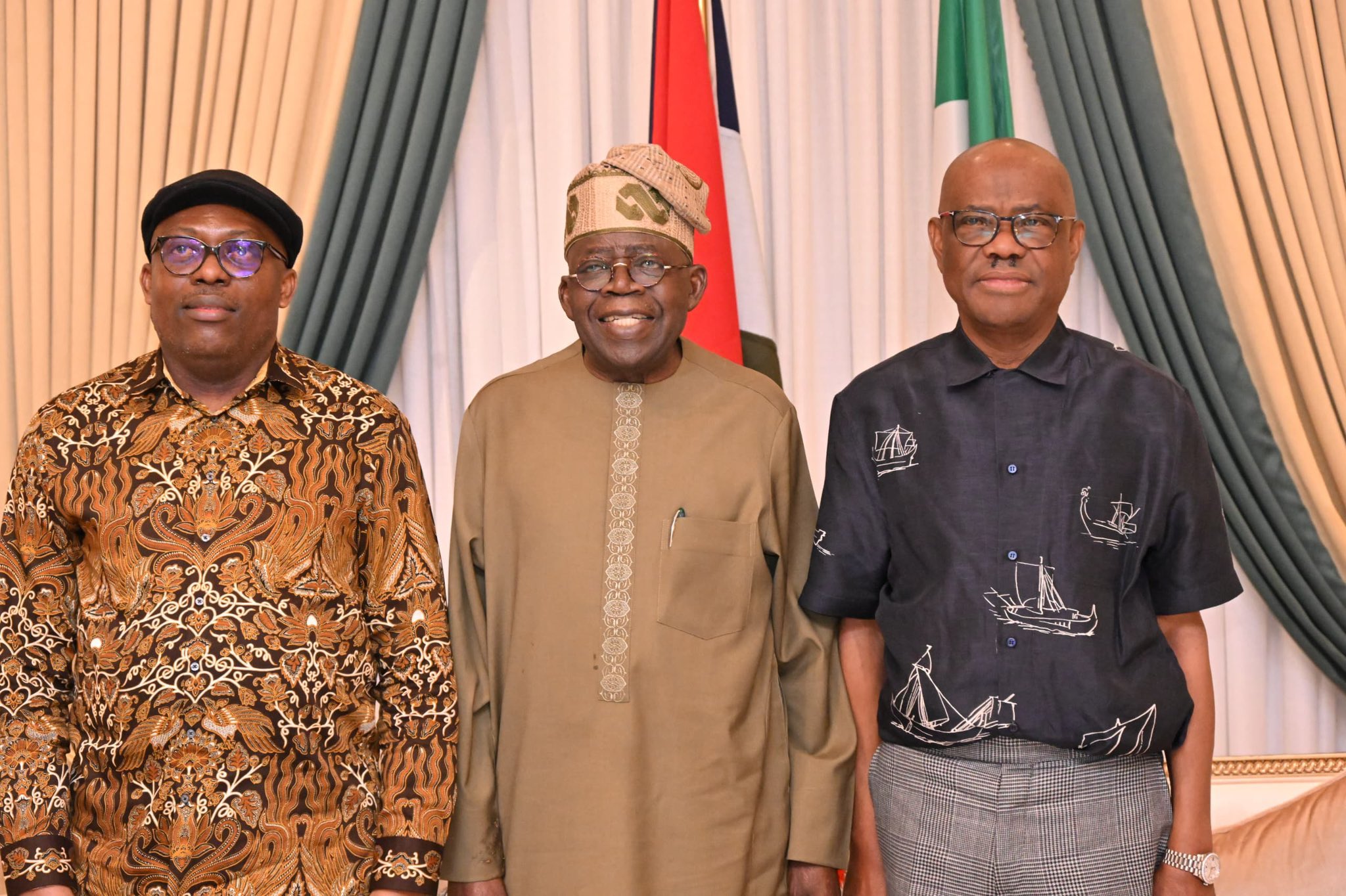
Rivers State politics has always existed in a space where power is personal, authority is contested, and loyalty is rarely permanent.
What is unfolding now is a collision between institutional power and personal dominance, between the idea of party supremacy and the reality of political godfatherism in Nigeria.
A few months after President Bola Tinubu lifted the state of emergency imposed on Rivers State, Governor Siminalayi Fubara made a strategic political move that was supposed to reset the chessboard. His defection from the Peoples Democratic Party (PDP) to the All Progressives Congress (APC) was widely interpreted as a bid to stabilise his government, align with federal power, and finally step out of the long shadow cast by his predecessor, Nyesom Wike.
In theory, the move should have been decisive. In Nigerian politics, a sitting governor is automatically his party’s leader in the state; structures fall in line, dissent is muted, and the centre consolidates control. But Rivers State has never operated by theory alone, and the events of the past few days have made that clear.
The controversy began when Victor Giadom, the APC’s South-South vice chairman, publicly referred to Fubara as a “so-called governor” while insisting that no one could win any election in Rivers State without the backing of Nyesom Wike. The comment was not just dismissive; it was a direct challenge to Fubara’s legitimacy and, by extension, to the authority of the APC as the ruling party in the state.
Ajibola Basiru, the APC’s national secretary, responded by drawing a line. He condemned Giadom’s remarks, stressing that an elected governor deserves respect regardless of internal party disagreements.
On the surface, it was a defence of institutional norms.
Beneath it, however, was something more significant: an assertion that the APC would not officially endorse the idea that Rivers State is controlled by someone who is not even a member of the party.
That response triggered a sharp and familiar reaction from Nyesom Wike.
Wike’s warning to Basiru to “stay clear of Rivers politics” was not diplomatic, nor was it intended to be. It was a declaration of territory. In one sentence, Wike reminded both the APC leadership and the wider political class that Rivers State remains, in his view, his political domain, regardless of party labels or formal positions.
Wike’s Influence and the Problem of Duality
Wike’s continued dominance in Rivers politics presents a unique dilemma for the APC. He is not officially a party member, yet he sits at the heart of the APC-led federal government as Minister of the Federal Capital Territory. He campaigns with the administration, defends it publicly, and remains one of its most visible political assets in the South-South.
At the same time, he retains deep influence over Rivers State’s political structures, from local leaders to party operatives and elected officials who still owe their relevance to his political machinery.
Victor Giadom’s comment reflected an uncomfortable truth many politicians privately acknowledge – that Wike’s influence did not disappear with Fubara’s emergence as governor, nor did it vanish with Fubara’s defection to the APC. If anything, the situation has become more complex. Wike now operates as a cross-party power broker, exerting pressure from outside the APC while enjoying the benefits of being a part of the federal government.
This is precisely what makes the current standoff dangerous for the party. Allowing a narrative to stand in which a member of a different political party effectively determines who holds authority within an APC-controlled state undermines the very idea of party supremacy. It suggests that personal influence matters more than structure, loyalty, or electoral legitimacy.
Basiru’s intervention, therefore, was not just about defending Fubara as an individual. It was about defending the idea that the APC, not any single political godfather, sets the rules within its own space.
Wike’s response shows that he sees things differently.
Fubara, Tinubu, and the Question of Intent
Caught in the middle of this power struggle is Governor Siminalayi Fubara — a man who holds the highest office in the state but is still fighting to define the extent of his authority. His defection to the APC was widely interpreted as a move encouraged, or at least welcomed, by President Tinubu. For some analysts, it represented a calculated attempt by the president to gradually reduce Wike’s grip on Rivers State without confronting him directly.
From this perspective, Fubara becomes more than just a governor; he becomes a tool of political recalibration. By strengthening Fubara within the APC, Tinubu could theoretically dilute Wike’s dominance over time, shifting loyalty from personality to party.
But Nigerian politics rarely rewards subtlety.
Wike is not a politician who retreats quietly. His power has always been rooted in control of structures, not just access to office. As long as those structures remain intact, Fubara’s authority, even as an APC governor, remains contested.
This is why Giadom’s comment resonated with so many insiders. It reflected the perception that Fubara governs with Wike’s tolerance, not independent command.
For Tinubu, the situation exposes the limits of coalition politics. His administration benefits from Wike’s support, but that support comes with expectations, including influence over Rivers State. The question is whether the president is willing, or even able, to enforce clear boundaries when those expectations clash with party authority.
Why Wike Hasn’t Decamped, and Why It Matters
Given his role in the APC-led government, the obvious question remains why hasn’t Wike formally joined the APC?
The answer lies in leverage. By staying in the PDP while working closely with the APC at the federal level, Wike maximises his influence. He keeps his options open, maintains relevance across party lines, and positions himself as indispensable to multiple political camps. In a system where alliances shift quickly, that flexibility is power.
Decamping would limit that leverage. It would subject Wike to internal APC politics, expose him to rival power blocs, and reduce his ability to play mediator or disruptor when necessary.
Remaining in the PDP while aligning with the APC allows him to enjoy the benefits of both without fully committing to either.
However, this arrangement is increasingly unstable. Basiru’s suggestion that Wike should resign from the government if he intends to interfere in APC affairs signals growing frustration within the party. The APC cannot indefinitely accommodate a powerful outsider who shapes its internal dynamics without eventually asserting control.
What This Means for Rivers and Nigerian Politics
For Fubara, the road ahead is narrow.
He must either assert himself decisively and risk open confrontation with Wike or continue navigating cautiously and risk being permanently framed as a governor without autonomy. His legitimacy is not in question, but his authority is.
For the APC, Rivers State has become a test case. If the party cannot establish clear leadership in a state where it now has the governorship seat, it sends a troubling signal about its ability to manage internal power struggles elsewhere.
And for Wike, the current moment is about preservation. He is defending not just influence, but relevance, proving that even without holding state office, he remains the central figure in Rivers politics for now.
In the end, this is not merely a clash of personalities. It is a confrontation between political eras: one defined by godfathers and personal loyalty, the other by party control and institutional authority. Rivers State sits at the intersection of both, and the outcome will shape not just the state’s future, but the balance of power within Nigeria’s ruling coalition.
For now, one thing is clear: Rivers State is no longer just a state-level issue. It is a national political fault line, and everyone involved is testing how much it can bend before it breaks.
Your opinion matters, please leave a comment