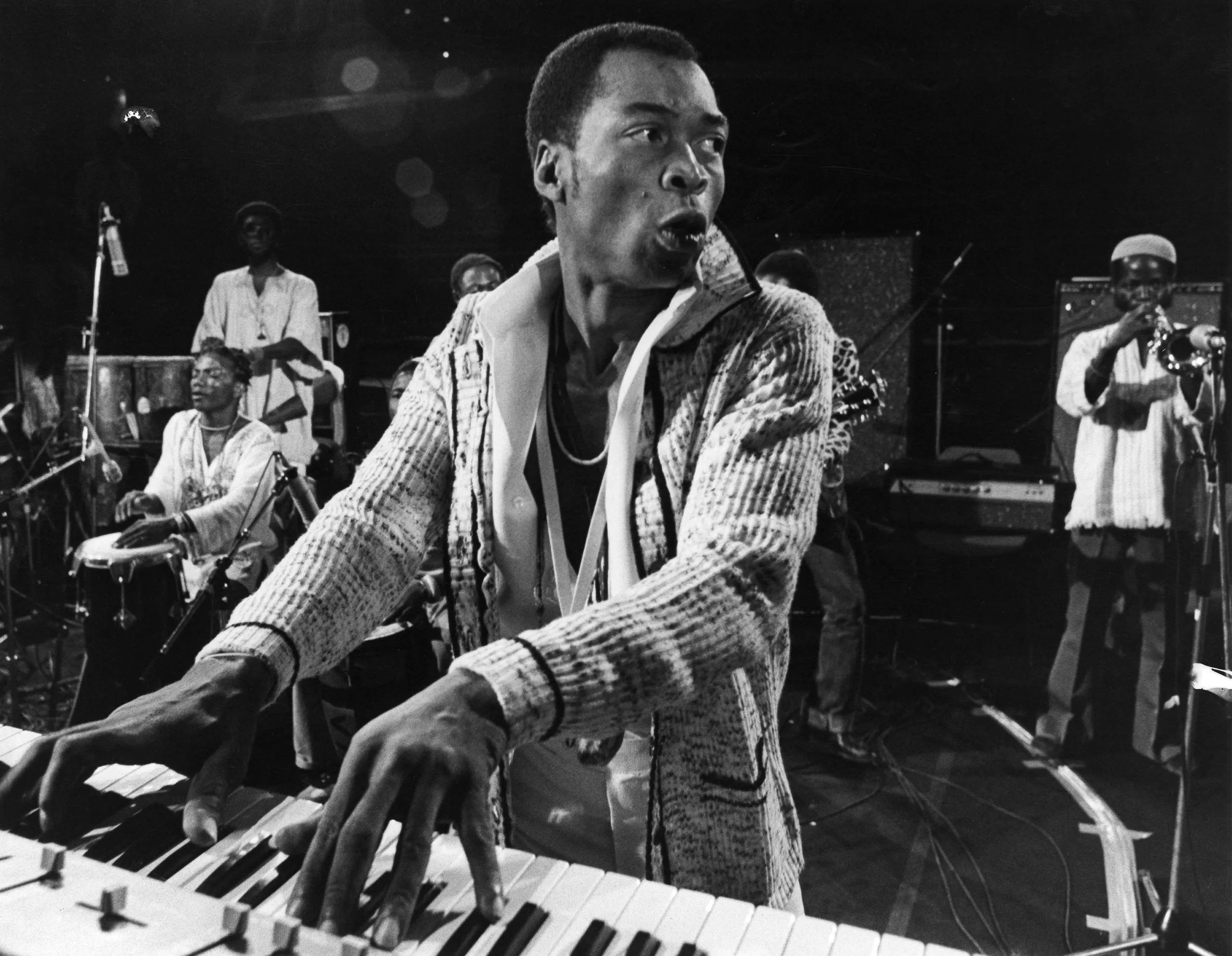
Every generation produces its heroes. Every era crowns its icons. But every now and then, fandom culture overreaches and drags history into a conversation it was never meant to survive.
That is exactly what happens when some netizens will every now and then, declare that Wizkid is a greater artiste than the legendary king of Afrobeat, Fela Anikulapo-Kuti.
Recently, this came up again and the reaction was swift. Backlash here, agreement there. And rightly so.
Let’s not confuse each other, this is not an anti-Wizkid article. Wizkid is one of the most successful Nigerian musicians of all time. He has redefined global access for Afrobeats, shifted pop aesthetics, and inspired a generation.
Fela’s son, Seun Kuti, did not just respond emotionally, he responded from a place of lineage, history, and lived ideology. Because for Nigerians who understand what Fela represented, this was not harmless stan culture, it was amnesia masquerading as online bravado.
But this conversation is not about the number of streams, Grammy plaques, Apple Music charts placements, or sold-out concerts. This is about impact. About sacrifice. About what it means to stand for something when it costs you everything.
And in that conversation, Fela does not just win. He exists on an entirely different planet.
Fela Anikulapo-Kuti Was Not Just a Musician
The first mistake some Wizkid fans (especially stans and the Wizkid FC faction) make is assuming Fela belongs in the same category as modern Nigerian pop stars. He doesn’t.
Fela was more than an entertainer. He was a political force, a cultural disruptor, a philosopher, a social agitator, a spiritual rebel, and an uncompromising enemy of the Nigerian state. Music was merely his weapon of choice.
While today’s artistes navigate brand deals, streaming algorithms, streaming farms, and government-backed cultural diplomacy, Fela stood directly in opposition to power. Not subtly. Not diplomatically. Not metaphorically. Directly.
He labelled Nigerian leaders thieves, murderers, colonial puppets, and oppressors, and called out names. He mocked military dictators on wax. He used his music as a courtroom, his stage as a protest ground, and his body as collateral damage.
Fela was arrested over 200 times. His mother, Funmilayo Ransome-Kuti, a feminist icon and anti-colonial activist, was thrown from a window during a military raid on Kalakuta Republic, an attack ordered by the Nigerian government. She later died from complications related to that assault. His home was burnt. His band members were brutalised. His music was banned on radio. His shows were spied on by security forces.
And yet, he never stopped.
This is the baseline. Any comparison that ignores this context is unserious.
Now, let us talk about all the types of ‘NewFela’ in the conversation.
Wizkid
Wizkid is phenomenal at what he does. Sonically, he represents the polished, globalised evolution of Nigerian pop music. He has mastered subtlety, vibe, emotion, and transnational appeal. His influence on Afrobeats’ global rise is undeniable.
But Wizkid is not, and has never claimed to be, a political revolutionary.
His music is inward-facing. Emotional. Romantic. Occasionally reflective. It is designed for enjoyment, not agitation. His brand thrives on alignment with corporate platforms, international institutions, and state-endorsed soft power narratives.
Even when Wizkid gestures at political consciousness, such as brief statements during the End SARS protests, it is cautious, non-confrontational, and quickly withdrawn when it threatens brand stability. This is not a flaw. It is simply the reality of modern pop stardom.
But to then elevate that model above Fela’s is to fundamentally misunderstand what greatness means in Nigerian cultural history.
Burna Boy
If there is any Nigerian contemporary artist who sometimes enters the same conversation as Fela, it is Burna Boy. And even Burna would reject the comparison himself. And he has!
Burna engages African identity, colonial trauma, global Black consciousness, and Pan-African pride far more aggressively than his peers. Albums like African Giant and Twice As Tall openly critique exploitation, Western hypocrisy, and post-colonial power dynamics.
But Burna’s rebellion is curated. Strategic. Global-market aware.
Fela’s rebellion was suicidal.
Fela did not code his messages for Western palatability. He did not balance activism with endorsement deals. He did not retreat when the state pushed back. While Burna criticises power from the safety of global superstardom, Fela’s art confronted power from within firing range.
One is resistance within capitalism. The other was war against the system itself.
2Baba, P-Square, D’banj, Davido
2Baba deserves immense respect. His activism during the early 2000s, particularly with songs like E Be Like Say and For Instance, positioned him as a socially conscious voice. His involvement in protests and advocacy appear sincere.
But even 2Baba operates within negotiation, not confrontation.
P-Square, D’banj, and Davido represent different arms of Nigerian pop excellence, commercial dominance, club culture, diasporic wealth, and entertainment spectacle. They are culture shapers, not system challengers.
Davido, for instance, has occasionally spoken on politics, for example during the End SARS protests, but he also maintains proximity to political elites and benefits from elite networks. Again, not a moral failure, just a different lane.
Fela did not have a lane. He set the road on fire.
The Political Angle
No Nigerian musician past and present has had a more antagonistic relationship with the Nigerian government than Fela.
Fela declared to run for president in 1979, not as a publicity stunt, but as an ideological statement. He rejected Western religion. He created his own communal system. He renamed himself “Anikulapo” – the one who carries death in his pouch, as a declaration of fearlessness.
Fela did not seek reform. He sought dismantling of existing systems or at least major restructuring.
Modern Nigerian musicians, by contrast, exist within a framework of negotiation with power. They attend government-sponsored events. They are invited to state dinners. They receive national honours. Their success is often celebrated by the system Fela spent his life trying to topple.
This is the clearest line of separation.
Social and Religious Defiance
Fela challenged Christianity and Islam as colonial instruments. He rejected Victorian morality. He openly practiced polygamy and to some regard, polyamory. He explored African spirituality unapologetically. He offended everyone including religious leaders, conservatives, elites, and foreign observers alike.
Modern artistes play it safe. Religion is treated delicately. Social norms are bent, not broken. Controversy has become mere aesthetics and part of a larger rollout plan, not ideological.
Fela did not care about being liked. He cared about being truthful.
Why This Comparison Continues to Rear Its Ugly Head
This controversy is less about Wizkid and more about stan culture’s obsession with: Metrics. Streams. Awards. Charts. Global recognition.
But history does not work like Spotify Wrapped.
Fela’s greatness cannot be quantified because it was NOT designed for applause. It was designed for resistance. His music still sounds dangerous decades after his mortal death because the problems he fought remain with us..
When the stans insist Wizkid is “greater than Fela,” what they are really saying is that commercial success has replaced courage as the measure of greatness.
And there lies unadulterated blasphemy.
Legacy Is Not Popularity
Fela is taught in universities. Studied in political theory. Referenced in liberation movements. Sampled not just musically, but ideologically.
Wizkid is loved. Fela is feared.
Wizkid makes moments. Fela made history.
You can enjoy Wizkid. You can celebrate him. You can call him the biggest Afrobeats artist of his era, and be correct.
But placing him above Fela is not just wrong. It is a profound misunderstanding of the African cultural DNA.
And that is why Seun Kuti’s reaction mattered. Because some legacies are not up for debate.
Your opinion matters, please leave a comment