In Nigeria, there is a phrase people use half-jokingly, half-defeated “Nigeria happened to me.” It is usually said after power fails at the worst possible moment, after a government office loses vital documents, or after a preventable tragedy unfolds with no consequences.
What makes the recent death of Nnamdi Nkanu, the son of acclaimed Nigerian writer Chimamanda Ngozi Adichie, so unsettling is that it strips this phrase of humour entirely. It shows, in the starkest terms, that Nigeria happens to everyone. Rich or poor, famous or unknown, connected or ordinary.
When a statement from Chimamanda’s media team was made public accusing a Lagos-based hospital of negligence which led to her son’s death, it immediately went viral and attracted instant reactions from far and wide Not because medical negligence is new in Nigeria, but because of who it happened to.
If someone with global influence, financial capacity, and access to private healthcare in most parts of the world can still lose a child in circumstances she describes as careless and avoidable, then it serves as a reminder that no one is safe. The illusion of immunity collapsed.
This is not just a story about grief. It is a mirror held up to a broken system.
The Incident
According to Chimamanda’s account, her 21-month-old son, Nnamdi, was admitted to Euracare Hospital in Lagos for routine medical procedures. These included an MRI scan and the insertion of a central line, preparatory steps for onward treatment abroad. Nothing about the situation suggested imminent danger. This was meant to be controlled, professional medical care in a private facility often associated with quality.
Instead, Chimamanda alleges that her son was administered a sedative and left inadequately monitored. She claims that excessive medication was given, oxygen monitoring was insufficient, and early warning signs were missed. By the time the severity of the situation became clear, her son had become unresponsive. What followed were seizures, cardiac complications, and ultimately, death.
Her words were not vague. She described the conduct as negligent, alarmingly casual, and deeply disturbing. More troubling is the implication that such behaviour may not be isolated, that systems exist in Nigeria where medical professionals operate without adequate accountability, supervision, or consequence.
The shock was not just in the loss, but in how ordinary the failure sounded to many Nigerians.
Nigerians are no strangers to hospital horror stories. People die waiting for doctors who never arrive. Others die because power failed mid-procedure. Some are turned away for lack of payment before treatment. These stories are so common that they rarely spark local outrage.
What made this case different was not the negligence itself, but the victim’s proximity to privilege. Chimamanda represents the class Nigerians often believe can escape systemic failure, those who can afford private hospitals, international care, and elite access. Her loss dismantled the comforting lie that money guarantees safety.
This tragedy reinforced a painful truth that Nigeria’s healthcare crisis is not selective. It does not discriminate by bank balance, reputation, or global acclaim.
When systems are weak, everyone bleeds.
Nigeria’s healthcare sector has been described as underfunded, overstretched, and structurally neglected for decades. The government’s budget for the public health sector consistently falls below international benchmarks, leaving hospitals in survival mode. Infrastructure is outdated, equipment is poorly maintained, and many facilities rely on improvisation rather than preparedness.
Even in private hospitals, which are often assumed to be better run, the same systemic weaknesses persist. They depend on the same pool of healthcare professionals trained in the same environment, regulated by the same weak oversight institutions, and affected by the same national dysfunction. A modern building does not automatically translate to safe care.
In a system where protocols exist mostly on paper, outcomes depend dangerously on individual diligence rather than institutional reliability.
The Human Cost of the Healthcare ‘Japa’ Exodus
One cannot discuss Nigerian healthcare without addressing the mass exodus of medical professionals. Doctors, nurses, anesthetists, and specialists are leaving the country at unprecedented rates. They are seeking better pay, safer working conditions, and functional systems abroad.
What remains is a workforce stretched beyond capacity. Overworked doctors handling overwhelming patient loads. Fatigue becoming the routine. Mistakes becoming more likely. Continuous training suffering. Supervision weakening. In such an environment, something as delicate as a pediatric sedation becomes a high-risk exercise.
Chimamanda’s account raises a disturbing question. Was this negligence an anomaly, or the predictable outcome of a system operating under pressure with insufficient safeguards?
Globally, sedation, especially in children, comes with strict monitoring requirements. Oxygen levels, heart rate, respiratory response, and consciousness must be continuously observed. These are fundamental standards of care.
When such protocols are ignored or loosely applied, it speaks to a deeper cultural problem in Nigerian healthcare, which is the normalisation of shortcuts. Over time, deviation from best practice becomes routine. Routine becomes culture. Culture becomes deadly.
This tragedy forces an uncomfortable reckoning with how often Nigerians accept substandard care because it has become so familiar.
Many Nigerians who can afford to, flee public hospitals for private ones, believing they are buying safety. Chimamanda did the same but sadly, the anyhowness of Nigeria’s health sector reared its ugly head again.
Private healthcare in Nigeria often operates without robust regulation. Oversight bodies are weak, sanctions are rare, and the consequences for malpractice remains minimal. Patients have little recourse beyond public outrage. Lawsuits are expensive, slow, and emotionally draining.
Without accountability, negligence reproduces itself.
The Sacredness of Human Life and National Orientation
Beyond infrastructure and staffing lies a deeper issue regarding how Nigeria values human life. In countries with functional systems, preventable death is treated as a scandal. Investigations follow. Heads roll. Reforms are implemented. In Nigeria, outrage fades, news cycles move on, and nothing changes.
This cultural resignation is lethal. When loss becomes routine, urgency disappears.
Chimamanda’s grief challenges Nigerians to reject this fatalism. Her voice disrupts the silence that often follows tragedy. It demands that life, especially the life of a child, be treated as sacred.
Nigeria has policies, committees, and strategic documents on healthcare reform. What it lacks is consistent execution. Budgetary allocations are inadequate. Corruption siphons funds. Political leaders prefer to seek medical treatment abroad, insulating themselves from the consequences of domestic failure.
As long as decision-makers do not depend on Nigerian hospitals, systemic reforms will remain optional.
The loss of little Nnamdi Nkanu is a national indictment. It exposes the fragility of systems Nigerians rely on every day. It confirms fears many whisper but rarely confront directly.
This was not supposed to happen. Not to someone like Chimamanda. Not to anyone.
Yet it did.
If Nigeria is serious about preventing future tragedies, reforms must go beyond condolences. Healthcare funding must increase meaningfully. Staff welfare must improve to stem the brain drain. Training and certification must be continuous, not optional. Monitoring and enforcement must carry consequences. Medical negligence must be investigated transparently, regardless of status.
Most importantly, Nigerians must reject the idea that suffering is normal.
Nigeria Happens, But It Should Not Be Normalised
Nigeria should not be a place where losing a child to preventable medical failure is met with just shrugs and hashtags.
If this can happen to Chimamanda, it can happen to anyone. And until Nigeria confronts that truth honestly, it will keep happening to people without global platforms, without media attention, and without justice.
Nigeria happened. But it does not have to keep happening.
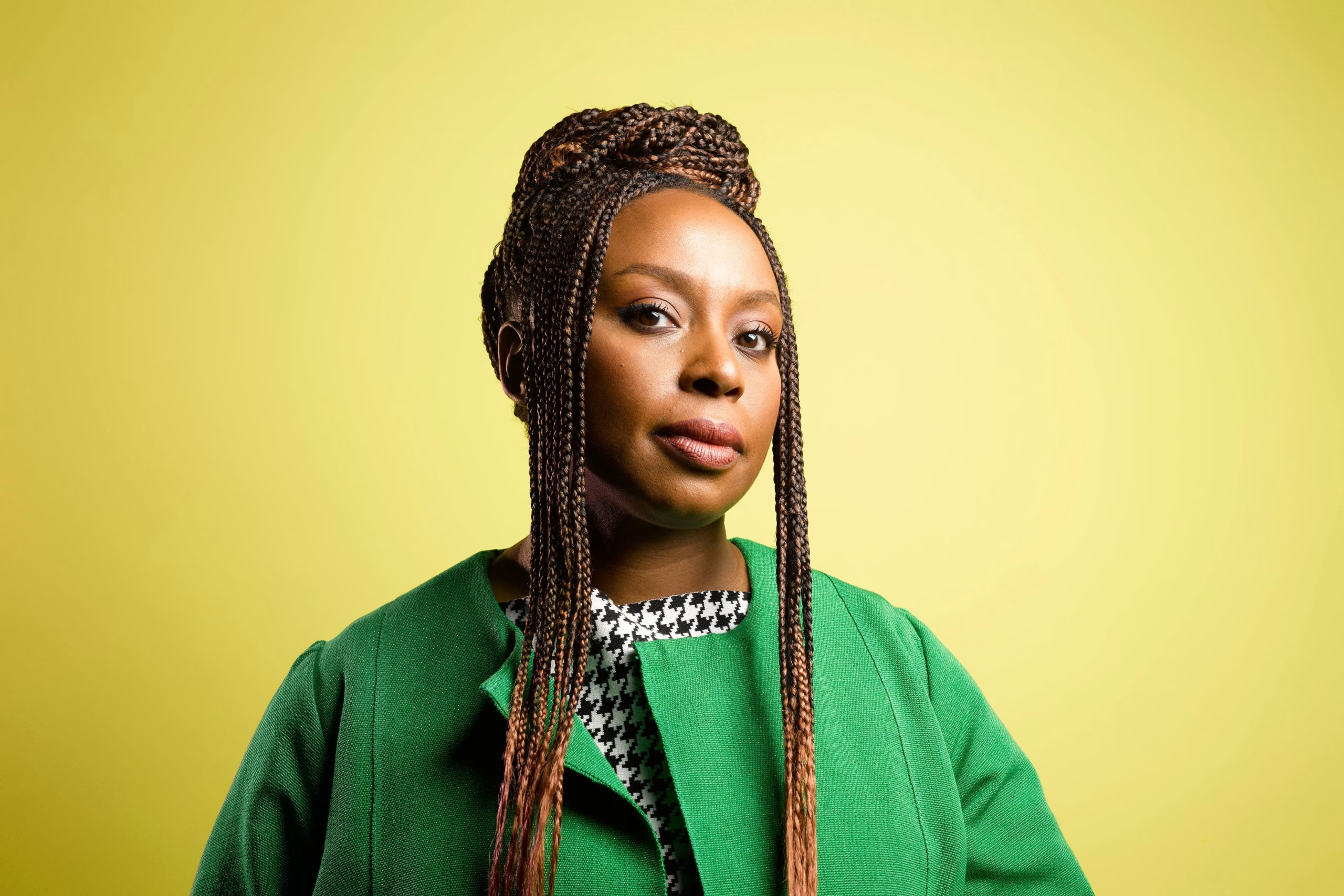
Featured Image credit: Richard Ansett/BBC
Your opinion matters, please leave a comment