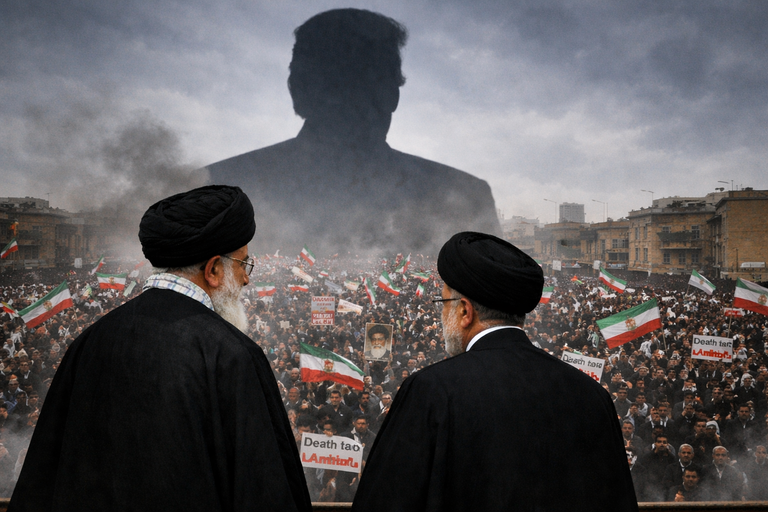
What began as scattered economic protests across Iranian cities has now hardened into one of the most dangerous political crises the country has faced in years.
In a matter of weeks, demonstrations driven by rising prices and collapsing living standards have spiraled into violent confrontations, a deadly state crackdown, heightened diplomatic pressure and international attention.
With human rights groups reporting that hundreds of people have been killed, Iran is no longer just battling dissent on its streets, it is navigating a high-stakes geopolitical storm involving the United States, Israel, and exiled opposition figures tied to its pre-revolution past. The exact number of lives lost remain contested and difficult to independently verify at this time.
This moment feels familiar yet different. Familiar because Iran has seen protests before. Different because this time, the economic collapse is deeper, the symbols of resistance are bolder, and the international rhetoric is louder and more explicit than at any point in recent memory.
The Pressure Cooker That Finally Exploded
The roots of the current unrest are not hard to trace. Iran’s economy has been under sustained pressure for years, battered by sanctions, mismanagement, and regional conflicts that have drained state resources.
By late 2025, the situation had become unbearable for ordinary citizens. Inflation surged past levels that made everyday essentials inaccessible.
The local currency, the Rial continued its free fall, wiping out savings and destroying purchasing power almost overnight.
Protests initially erupted in markets and commercial districts, places where economic pain is felt first and loudest. Traders, shop owners, and workers poured into the streets to express frustration over price hikes and currency instability.
At first, the chants were narrow in focus, aimed at economic relief rather than political change. But as demonstrations spread from Tehran to provincial cities and university campuses, the tone shifted.
Economic grievances quickly merged with long-standing political anger. What started as a demand for relief turned into a rejection of the system itself.
Protesters began openly criticising the clerical leadership, crossing red lines that the Iranian state has historically responded to with force.
Violence Takes Centre Stage
The Iranian government’s response followed a familiar script, but on a much harsher scale.
Security forces moved in aggressively, deploying riot police, plain-clothes operatives, and armed units to disperse crowds.
In several cities, live ammunition was reportedly used. Internet access was throttled and, in some areas, completely shut down, cutting protesters off from one another and from the outside world.
As the days passed, reports of deaths mounted. Human rights groups estimate the death toll to be in hundreds (some even suggest far higher numbers), though the true numbers remain unknown as a result of communication blackouts and restricted access to affected regions.
Thousands more have been detained. Stories emerging from inside Iran describe families pressured into silence, hurried burials, and security forces maintaining a visible presence even at funerals.
The scale of the violence marked a turning point. The protests were no longer just a domestic crisis; they had become an international human rights issue, drawing attention from foreign governments and global media.
Trump Enters the Picture
The crisis took on a new dimension when the U.S. President Donald Trump weighed in publicly.
Early in the unrest, Trump issued a stark warning to Tehran, stating that he did not want to see protesters killed while suggesting that continued violence could attract consequences without giving details on any specific diplomatic or military action to be taken.
The message was blunt and unmistakable, delivered in a tone that recalled earlier periods of the U.S-Iran confrontation.
As the death toll climbed, Trump doubled down, suggesting that if conditions did not improve, the United States might take further action. While no concrete military intervention plans were outlined, the employment of more forceful rhetoric was enough to unsettle both Tehran and the wider region.
For protesters inside Iran, Trump’s comments were polarising.
Some interpreted them as a form of international protection, believing that global scrutiny could restrain the regime’s worst impulses. Others feared that such statements would hand the government a convenient excuse to frame the protests as a foreign-backed conspiracy.
Tehran’s Counter-Narrative: Blaming Washington and Tel Aviv
Iran’s leadership wasted little time in crafting its response. Senior officials and state media accused the United States and Israel of orchestrating and fuelling the unrest.
According to Tehran, the protests were not an organic expression of public anger but part of a broader campaign to destabilise the Islamic Republic.
This narrative is deeply rooted in Iran’s political history.
Memories of the 1953 coup, decades of sanctions, and ongoing tensions with Israel have long shaped how the state explains internal dissent. By casting the protests as a foreign plot, the government sought to justify its heavy-handed response while rallying nationalist sentiment. It is pertinent to note that there’s no independent evidence at this time clearly showing that the protests were orchestrated by foreign governments. Most reports suggest that the protests are primarily being driven domestically.
Warnings soon followed. Iranian officials stated that any direct intervention by the U.S. or Israel would provoke retaliation, raising fears that a domestic uprising could escalate into a wider regional confrontation.
Ghosts of 1979
One of the most striking aspects of the current protests has been the re-emergence of pre-revolution symbols. Outside Iran, particularly in Europe and the United Kingdom, demonstrators have been seen waving the old Iranian flag associated with the era before the 1979 Islamic Revolution.
These images carry heavy symbolism, evoking memories of monarchy, secularism, and a radically different national identity.
Adding to this is the renewed visibility of Reza Pahlavi, the son of Iran’s last Shah.
From exile, he has been making media appearances, including on conservative U.S. outlets like Fox News, presenting himself as a unifying figure for opposition forces and calling for fundamental change in Iran.
For the Iranian government, this development reinforces claims of foreign meddling and counter-revolutionary intent. For some protesters and members of the diaspora, however, it represents an alternative vision of Iran’s future, one untethered from clerical rule.
A Protest Movement Without a Single Face
Unlike some past uprisings, the current protests lack a central leader or unified organisational structure inside Iran. This decentralisation has made the movement harder to crush completely, but it has also complicated efforts to translate street anger into a coherent political programme.
Young people, students, workers, and middle-class professionals have all played visible roles. The absence of a single ideological banner suggests that the protests are less about replacing one elite with another and more about a broad rejection of economic hardship, political repression, and lack of opportunity.
At the same time, the involvement of exiled figures and foreign voices risks muddying the waters, giving the state ammunition to dismiss genuine grievances as externally engineered.
What This Moment Means for Iran’s Future
The protests have exposed profound fractures in Iranian society.
Economic hardship has stripped away the legitimacy that ideological rhetoric once provided, especially among younger generations with little memory of the revolution’s early years. The return of old symbols and the prominence of exiled voices show a population searching for identity as much as relief.
Whether this moment leads to systemic change remains uncertain. The state still commands powerful security forces and has shown its willingness to use them. Yet the scale of the unrest and the intensity of global attention suggest that a simple return to the status quo may be impossible.
Iran now stands at a crossroads.
What began as protests over bread and currency has evolved into a broader confrontation over power, identity, and the country’s place in the world. The streets may eventually quiet, but the questions raised by this crisis will linger long after the last protest fades from view.
Your opinion matters, please leave a comment