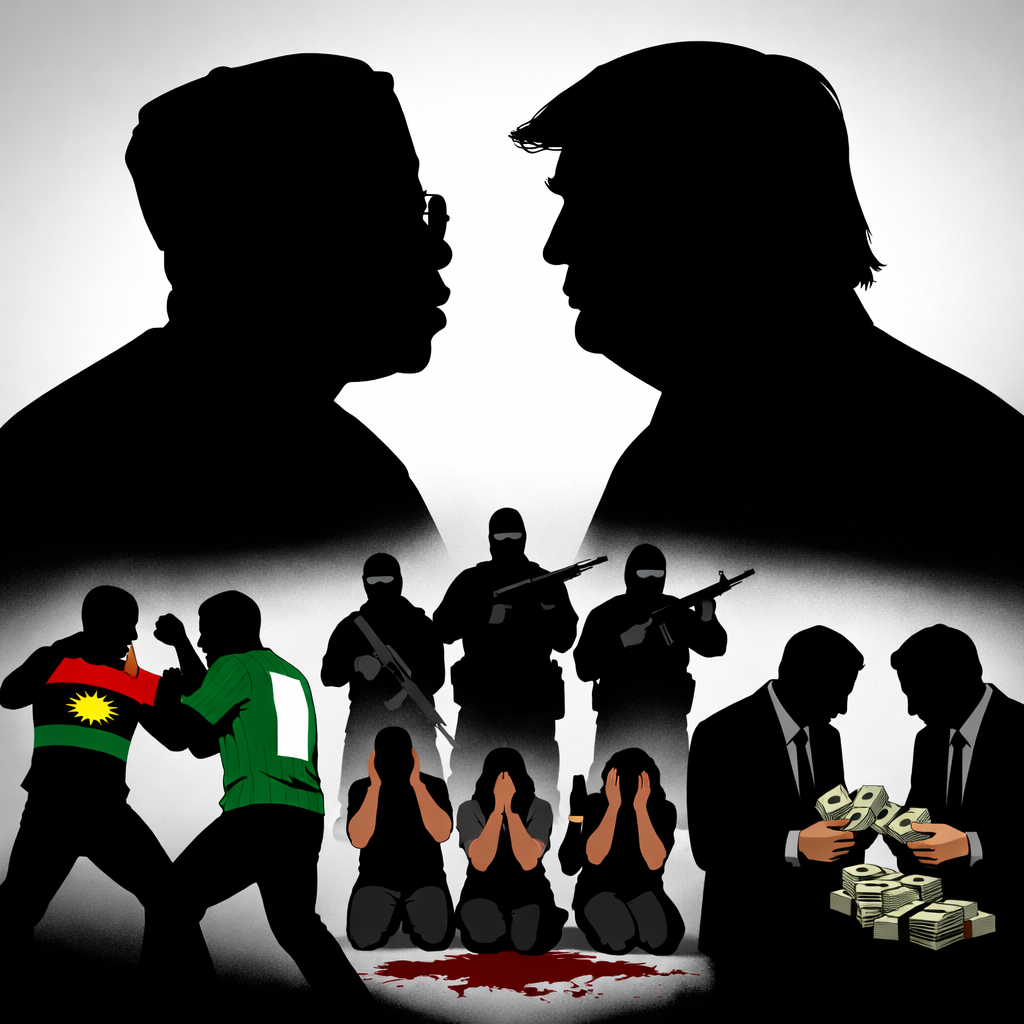
News recently broke that Nigeria’s Federal Government had signed a $9 million contract with a U.S.-based lobbying firm, DCI Group, to help “communicate” its actions on protecting Christians in Nigeria to the United States government.
Of course, social media served outrage, sarcasm, conspiracy theories, and long threads dissecting every dollar sign in the reported deal.
But this story presents a plot twist. It was also revealed that a pro-Biafra group is also paying about $60,000 to sell its own narrative of Igbo persecution in Nigeria to U.S. policymakers.
At $750,000 monthly, the Nigerian government’s reported engagement with DCI Group is meant to counter popular belief in some Western political and evangelical circles, that Nigeria is systematically persecuting Christians.
As expected, the move has fractured opinion at home and abroad. Some see it as smart, even necessary. Others see it as embarrassing, wasteful, and morally hollow. And a third, more unsettling school of thought insists that both sides are losers in a grim PR war funded by Nigerian blood.
To understand why this issue has struck such a nerve, you have to look beyond the headline figures and into the politics of perception, power, and pain.
Lobbying in Washington is not a dirty word. It is an industry, a tradition, and in many ways, a prerequisite for relevance. Governments, corporations, NGOs, rebel movements, and even city councils spend millions each year to shape how U.S. lawmakers, think tanks, and media understand their issues.
Nigeria is not new to this game. What makes this moment different is the subject matter. This is not about trade, oil, or visa approvals. It is about death, faith, and identity.
Claims of Christian persecution in Nigeria have gained traction in the U.S. for years, particularly among conservative lawmakers and religious advocacy groups. These claims have influenced congressional hearings, State Department reports, and even discussions about sanctions and religious freedom watchlists.
From the Nigerian government’s perspective, silence is not neutrality. In Washington, silence often means your enemies get to define you. Supporters of the lobbying deal argue that Nigeria cannot afford to let one-sided narratives harden into U.S. foreign policy positions.
If the country is to avoid punitive actions or diplomatic isolation, it must speak in the language Washington understands, and that language is professional lobbying.
FG’s Case: “If You’re Not at the Table…”
Those defending the Tinubu administration’s decision say the outrage is naive. The U.S. government does not simply react to moral appeals. It reacts to structured, persistent, well-funded advocacy. Reports do not circulate themselves. Briefings do not arrange themselves. Lawmakers do not magically stumble into nuance.
From this angle, the reported $750,000 monthly fee is insurance. Insurance against being branded a religious apartheid state. Insurance against congressional sanctions. Insurance against the kind of reputational damage that can scare away investors and complicate diplomatic relationships.
They also argue that Nigeria is uniquely vulnerable to mischaracterisation. The country’s security crisis is complex: banditry, insurgency, communal clashes, criminal kidnappings, and terrorism overlapping in ways that defy simple religious binaries.
Reducing all this to “Christians versus Muslims” is analytically lazy, but it is politically convenient for advocacy groups abroad. Lobbyists, in this view, are hired to inject complexity into a system that thrives on simple villains.
The Emotionally Potent Alternative
On the other side, the revelation that a pro-Biafra group is paying $60,000 to lobby the same U.S. political ecosystem adds another layer of irony. The price difference alone tells a story. The Nigerian state is paying nearly a million dollars a month while the separatist group is operating on what looks like a discounted budget.
But lobbying is not only about money. It is about emotional clarity. Claims of Igbo persecution, historical marginalisation, and state violence fit neatly into a global human rights framework. They are easier to package, easier to dramatise, and easier to moralise. In a world where attention is scarce, victimhood often travels faster than complexity.
For supporters of the Biafra cause, lobbying Washington is survival. If the Nigerian state uses global power structures to protect itself, why shouldn’t aggrieved groups do the same? In their eyes, the battlefield is asymmetric, and internationalisation is the only way to level it.
In the End, Everybody Loses, Except the Lobbyists
This is where the most devastating truth lies. Both Nigeria and the pro-Biafra groups are engaged in a grotesque competition that benefits only one constituency: Washington lobbyists.
While Nigerians are killed by bandits, insurgents, and criminal networks, dollars are being wired abroad to “manage perception.”
The dead do not get justice; their stories get monetised. Each massacre becomes a data point in a briefing memo. Each tragedy becomes content for a lobbying pitch.
No amount of PR can substitute for actual security. If Nigeria truly wants to counter narratives of Christian persecution, the solution is fewer funerals. If separatist groups want global sympathy, the solution is evidence of sustained, good-faith political engagement at home.
From this angle, the lobbying war is not just ineffective, it is obscene. It signals a political elite more invested in optics than outcomes. It suggests a country trying to explain violence rather than end it.
PR Versus Reality and The Limits of Narrative Control
There is also a strategic question that critics raise. Which is if lobbying can even work in this case? Washington is not ignorant of Nigeria’s problems. U.S. intelligence agencies, diplomats, and NGOs have their own data, their own field reports, and their own sources. Lobbyists can frame, contextualise, and soften narratives, but they cannot erase reality.
If killings continue, if prosecutions remain rare, if communities keep accusing the state of bias or indifference, no amount of monthly retainers will fully rehabilitate Nigeria’s image. At best, lobbying buys time. At worst, it delays accountability.
The Tinubu Factor and the Cynical Interpretation
Then there is the most cynical interpretation of all. Some believe President Bola Ahmed Tinubu knows exactly how Washington works, not just institutionally, but personally.
Longstanding rumours about his past in the United States, some proven, some exaggerated, some unresolved, have fuelled speculation that he understands American power dynamics at a granular level.
According to this line of thinking, Tinubu’s restraint during periods of intense foreign scrutiny is not weakness, it is calculation. He knows when to speak, when to stay quiet, and when to outsource the talking to professionals who can navigate Capitol Hill without emotion. From this perspective, the DCI Group contract may not be desperation, but could be muscle memory.
Whether this interpretation is fair or fanciful, it reveals a truth that Nigerian politics does not exist in isolation. Personal histories, global networks, and unspoken understandings all shape decision-making in ways the public rarely sees.
A Nation at a Crossroads of Substance and Spin
What this controversy ultimately reveals is a nation struggling with how it is seen and how it actually is. Nigeria wants to be understood as complex, not cruel. Diverse, not divided. Chaotic, perhaps, but not genocidal. Yet the gap between intention and perception is widening, and money alone cannot close it.
The real tragedy is that while Nigeria and its critics argue over narratives in Washington, ordinary Nigerians continue to live inside the story that no lobbyist can rewrite. In insecurity, fear, and unresolved grief.
Until the killings end, until justice becomes visible, and until the state prioritises protection over presentation, every dollar spent on lobbying will raise the same uncomfortable question about whose cause the money really is for?
In the end, Washington may hear Nigeria’s voice louder. Or it may hear the dissenters’ cries more clearly. But unless Nigeria fixes what is happening on its own soil, the loudest sound in the room will remain the silence of the dead, and no lobbying firm, however expensive, can spin that away.
Your opinion matters, please leave a comment