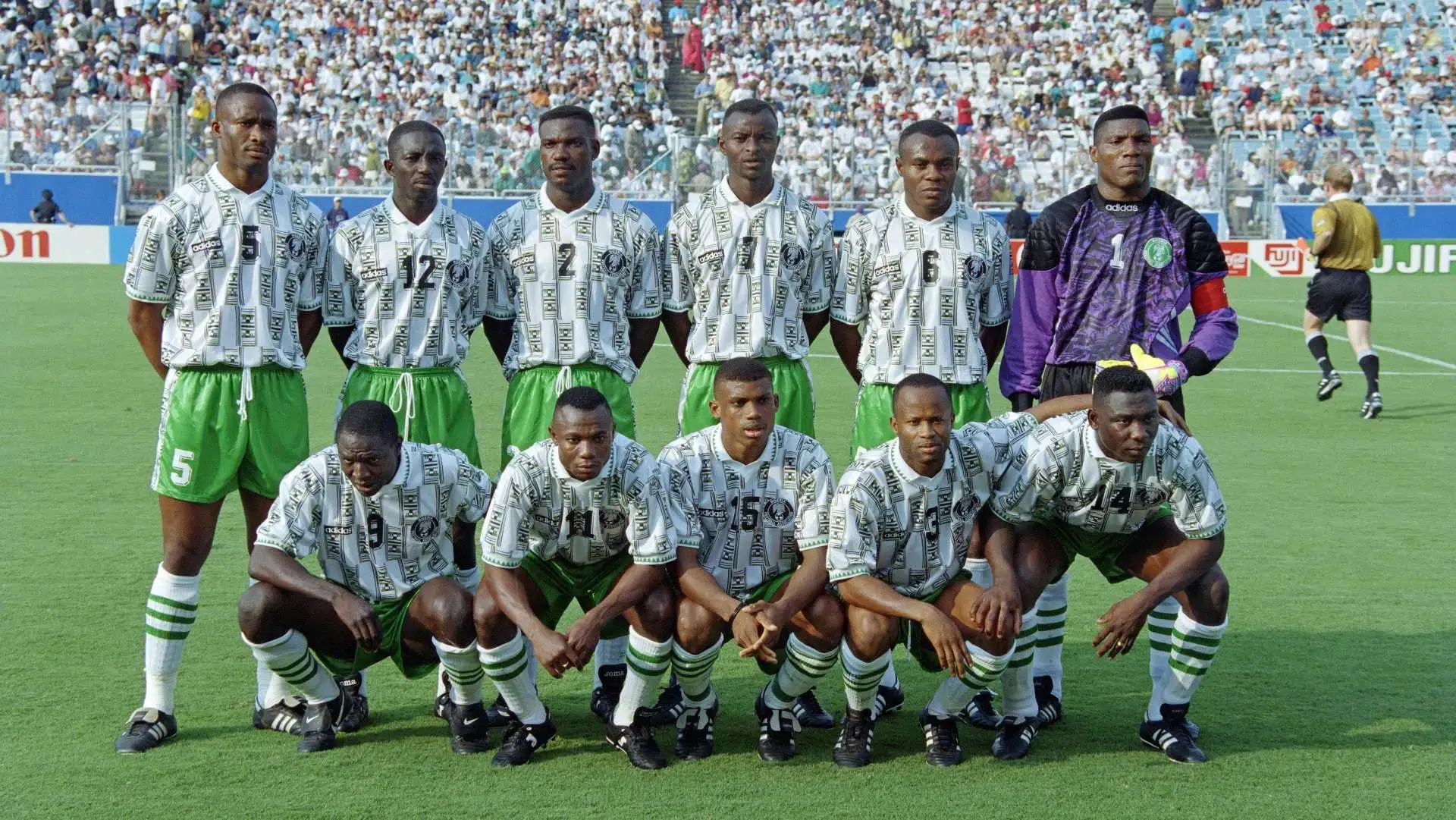
There are football teams that win trophies, and there are teams that change how a country is seen forever. Nigeria’s Super Eagles Class of 1994 falls firmly into the second category. Long before Nigerian players featured regularly in Champions League knockouts, before European clubs built recruitment pipelines across West Africa, and before “Naija to the world” became a mantra, there was a group of players who announced Nigeria’s arrival with zero apologies.
They became reference points. They reshaped expectations. And both now live under the intense scrutiny of hindsight.
But nostalgia is powerful and yet dangerous.
Decades later, the real debate is no longer about what these players achieved, but what their legacy means today.
Are the Super Eagles of ’94 truly Nigeria’s golden generation, especially in an era where Nigerian footballers are thriving globally at unprecedented levels? Has their status evolved into entitlement, particularly when those who came after seem unable to eclipse them?
These are uncomfortable questions, but they are necessary ones.
When Nigeria Stepped Onto the World Stage
To understand the Super Eagles Class of ’94, context is required.
Nigerian football before the early 1990s was respected within Africa and admired at youth level, but it did not command global attention. European clubs were not actively scouting Nigeria. Nigerian players abroad were exceptions, not trends.
Then came the 1994 Africa Cup of Nations in Tunisia.
This was not a scrappy, survival-style triumph. It was dominant, confident, and expressive. Stephen Keshi marshalled the backline with authority. Rashidi Yekini bulldozed defences and became the face of Nigerian football with his iconic goal celebration. Emmanuel Amuneke delivered when it mattered most. Sunday Oliseh combined bite with intelligence. Finidi George offered balance, discipline, and elite-level composure. Jay-Jay Okocha, still unpolished, hinted at a genius that would later enchant Europe.
Nigeria owned that AFCON.
That same year, the Super Eagles went to the United States for Nigeria’s first-ever World Cup appearance and played with the fearlessness of a team unaware of its supposed limitations.
They topped a group featuring Argentina and Bulgaria, stunned global audiences, and announced themselves as a new football force. The dramatic collapse against Italy in the round of 16 remains painful, but even that heartbreak became part of the mythology.
Nigeria had arrived, and the world had taken notice.
Four years later, they returned to the World Cup and reached the knockout stages again. This was no one-off. This proved consistency.
The Class of ’94 changed the perception about Nigerian football for good. They turned Nigeria from outsiders into a respected football nation.
Pioneers and the Price of Being First
One of the strongest arguments in favour of the Super Eagles Class of ’94 is that they were pioneers.
For the Nigerian players of the 1990s, Europe was not a welcoming marketplace.
When Finidi George established himself at Ajax, when Amokachi broke through abroad, when Okocha dazzled in Germany, they were not beneficiaries of a globalised scouting network. They were test cases. They carried the burden of representing an entire football culture with every performance.
Today’s Nigerian stars operate in a completely different ecosystem. Victor Osimhen is a marquee signing and a global brand. Ademola Lookman is a Europa League final hero. Wilfred Ndidi was a Premier League mainstay. Victor Boniface, Samuel Chukwueze, Alex Iwobi, Taiwo Awoniyi and others are products of a system that now demands Nigerian excellence.
The path they now walk was paved by the Class of ’94.
Being first does not automatically mean being the best, but it often guarantees a louder place in history.
From Mentors to Gatekeepers?
Where the debate becomes uncomfortable is in how some members of the Class of ’94 engage with the present.
Nigerian football media is saturated with critiques from former internationals: accusations of poor mentality, lack of patriotism, tactical ignorance, and insufficient hunger from the current crop of players.
Some of this criticism appears fair. The Super Eagles, given their talent pool, have often underperformed. But the tone frequently crosses from analysis into entitlement, as though Nigerian football peaked in the 1990s and everything since has been in decline.
To some, the constant public criticism from the Class of ’94 sometimes feels less like guidance and more like gatekeeping. Whether driven by frustration, passion for the country, fear of being surpassed, or a desire to protect their status, the effect is the same: tension between different generations of Nigerian footballers rather than collaboration.
Are They Truly the Golden Generation?
If the “golden generation” is defined purely by national team success, the Class of ’94 remains unmatched. An AFCON title, consistent World Cup knockout appearances, and the foundation for the Atlanta ‘96 Olympic gold medal place them in a category of their own.
But football has evolved and so have the criteria for defining greatness.
Today, Nigerian footballers are winning league titles in Europe, playing at elite clubs, and competing at the highest levels of club football. What they lack is not talent, but collective national achievement.
That gap is not necessarily a reflection of player quality. It speaks more to structural instability, administrative issues, and inconsistent technical direction.
The Class of ’94 benefited from a rare alignment of talent, leadership, and belief. That does not make them superior by default, it makes them fortunate as well as brilliant.
Would They Thrive in the Modern Game?
This question exposes both nostalgia and realism.
Football in the 2020s is faster, more tactical, and more physically demanding. Some members of the Class of ’94, particularly those with high technical intelligence, would adapt seamlessly. Others would struggle without significant evolution in their game.
But it is also true that they operated without modern sports science, analytics, nutrition, or exposure. Judging them by today’s standards without acknowledging those limitations is intellectually dishonest.
The fairest conclusion is that they would not automatically dominate today, but neither would they be out of place. Like every great generation, they would need to adapt.
Legacy, Progress, and the Danger of Frozen History
The Super Eagles Class of ’94 became the benchmark. Everything that followed has been measured against them.
That status is powerful, but it can also be limiting. When nostalgia becomes a ceiling rather than a foundation, progress stalls.
Nigeria does not need to dethrone the Class of ’94. It needs to contextualise them properly as trailblazers, not untouchable monuments.
Their greatest contribution should not be constant criticism of the present, but inspiration for the future.
Yes, Nigeria loves the Class of ’94 and rightfully so. They changed everything.
But football is not an old museum. It is a living, evolving sport.
The real test of their greatness is not whether newer generations match them immediately, but whether Nigerian football is allowed to grow beyond them. Legacy is most powerful when it opens doors, not when it guards them.
The Class of ’94 will always matter. The question is whether Nigerian football can honour them without being trapped by them.
Your opinion matters, please leave a comment