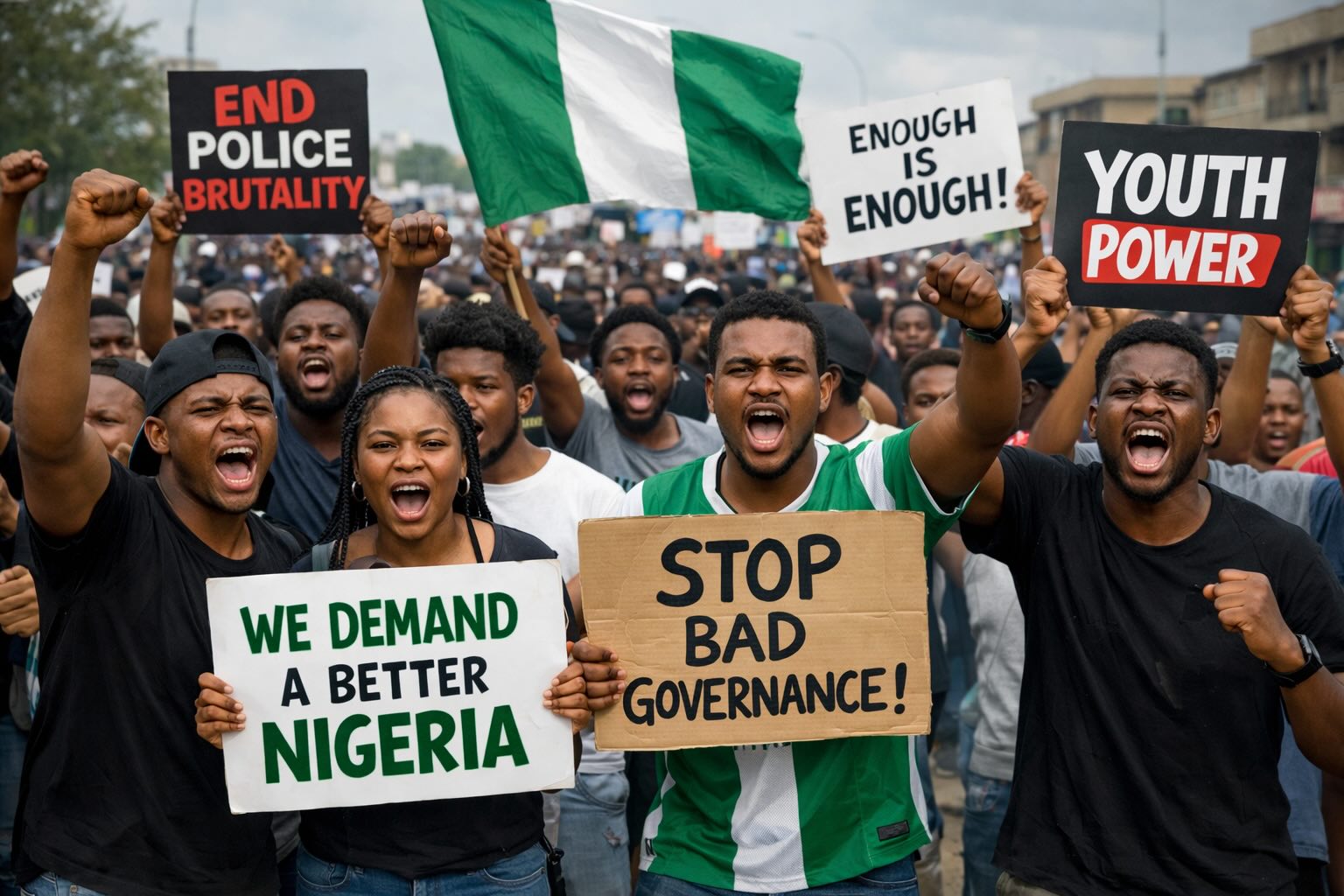
Nigerians are not lacking anger. If anything, outrage is one of the country’s most renewable resources. From fuel price hikes to police brutality, from electoral controversies to rising insecurity, Nigerians routinely respond with fury that floods timelines, dominates conversations, and sometimes spills into the streets.
For brief moments, the nation feels unified by a shared sense of injustice. And then, just almost immediately, the outrage fizzles out.
The hashtags stop trending. The protests thin out. Public attention moves on. Those in power remain largely unperturbed.
This pattern raises an uncomfortable but necessary question about why Nigerian outrage rarely lasts long enough to force structural political change?
A Country Familiar With Protest, But Not With Continuity
Nigeria’s relationship with protest is older than the republic itself. Anti-colonial resistance, student activism in the 1970s and 1980s, labour-led demonstrations, and mass protests against fuel subsidy removals all form part of a long tradition of civic anger.
More recently, the End SARS movement of 2020 demonstrated that Nigerian outrage could be youthful, organised, and globally visible.
Yet even in its most powerful moments, protest in Nigeria has struggled with continuity. Outrage tends to erupt around a specific flashpoint, peak rapidly, and then decline without translating into long-term political leverage.
This does not mean Nigerians are indifferent. Rather, it reflects a deeper structural problem. Protest often emerges faster than the systems needed to sustain it.
Anger mobilises crowds, but organisation sustains movements. In Nigeria, the former frequently arrives without the latter.
One of the clearest reasons Nigerian outrage fades is the absence of durable post-protest structures. Demonstrations often succeed in drawing attention but fail to build institutions capable of negotiating, monitoring, and enforcing outcomes.
When the streets are empty, there is rarely a clear body left to articulate demands, track promises, or apply pressure through legal, legislative, or electoral channels. Without continuity, governments can afford to wait out the storm.
Time, in Nigeria’s political system, is often a more powerful ally of the state than repression.
In countries where protests have produced lasting reform, outrage is usually followed by patient, sometimes boring work; committee meetings, policy drafts, court actions, and sustained civic engagement.
In Nigeria, public anger is still too often treated as an event rather than a process.
Fear as the Political Reality
Sustaining outrage in Nigeria is also dangerous. Protest is not merely inconvenient for the state; it is often met with force. The memory of security crackdowns, arbitrary arrests, and fatal encounters with law enforcement remains fresh in the national consciousness.
For many Nigerians, particularly those without economic safety nets, prolonged activism carries real risks. Losing a job, being detained, or becoming a target of surveillance can be devastating in a country where survival already requires constant improvisation. Under these conditions, sustained political engagement becomes a privilege few can afford.
Outrage may ignite courage, but fear shapes endurance.
Nigeria’s economic realities also explain why outrage struggles to last.
Inflation, unemployment, and the rising cost-of-living force citizens into a daily negotiation with scarcity. Political engagement competes directly with the urgent requirements for survival.
For someone worried about rent, food, school fees, or medical bills, sustained protests feel like luxury. The result is not indifference to injustice, but a rational prioritisation of immediate needs over long-term political battles whose outcomes are uncertain.
This economic pressure fragments attention and shortens the lifespan of public anger. Outrage becomes episodic, squeezed between shifts, daily hustle, and rising responsibilities.
Disillusionment With Political Alternatives
Another factor eroding sustained outrage is the lack of credible political alternatives. Many Nigerians view the political class as a closed ecosystem, where power circulates among familiar faces regardless of party labels.
When protests erupt, opposition figures often appear supportive, only to disappear once the moment passes. This pattern has bred deep cynicism. If the perceived alternatives look no better than those in power, outrage loses direction.
Political anger without a believable destination eventually crumbles. Protesters begin to ask not only what they are against, but what they are standing for. When no convincing answer emerges, momentum fades.
Social Media as an Amplifier, Not the Sustainer
Digital platforms have transformed outrage into a visible, viral phenomenon. Twitter, Instagram, and TikTok can elevate grievances within hours, drawing international attention and forcing official responses.
But social media thrives on novelty. Algorithms reward intensity, not duration. Once a topic stops generating engagement, it disappears from feeds, regardless of whether the underlying issue has been resolved.
This creates a cycle in which outrage peaks dramatically but lacks mechanisms for slow, sustained pressure. Online activism amplifies emotion but struggles to translate visibility into institutional change.
The Subtle Limits of Collective Action
Nigeria’s diversity, while culturally rich, complicates collective political action. Ethnic, religious, and regional identities often shape how outrage is interpreted and sustained. A grievance that mobilises one group may be dismissed or reframed by another.
Political actors frequently exploit these divisions, reframing national issues as regional concerns. As unity fractures, outrage loses the broad base required to exert lasting pressure on power.
The result is a cycle of intense but narrow mobilisation, followed by fragmentation and eventual decline.
The Nigerian state has learned that it does not always need to defeat outrage, it only needs to wait it out. Temporary concessions, vague promises, or symbolic gestures are often enough to calm tensions until public attention shifts.
In the absence of sustained civic pressure, these tactics work – anger cools, life resumes, and structural issues remain prevalent. Outrage then becomes part of the political rhythm rather than the disruptive force.
Perhaps the most underestimated factor is emotional and mental exhaustion. Nigerians have protested many of the same issues for decades: corruption, insecurity, poor governance, economic mismanagement. When similar grievances resurface without meaningful resolution, hope erodes.
Repeated disappointment breeds resignation. Over time, outrage begins to feel futile. The question shifts from “How do we change this?” to “What is the point?”
This fatigue does not reflect weakness. It reflects a population that has invested emotional energy repeatedly with limited or no returns.
Why Outrage Still Matters
Despite its short lifespan, Nigerian outrage is not meaningless. It reshapes public discourse, exposes abuses, and signals limits to the instruments of state. It educates citizens, builds networks, and leaves behind a residue of political awareness that does not entirely disappear.
Each wave of anger adds to a growing arch of resistance. Even when immediate victories are limited, the long-term effect is a population more aware of its power and its problems.
For Nigerian outrage to last, it must evolve. Anger must be oiled by organisation. Visibility must lead to structure. Protest must be linked to long-term civic participation, electoral engagement, and institutional reforms.
Achieving such strucutres require patience, leadership, unity, and a willingness to push beyond the adrenaline of the moment. It requires treating outrage not as mere emotional release, but as the opening chapter of a longer political project.
Until then, Nigerian outrage will continue to burn brightly and briefly but might never be a force that reshapes the system it challenges.
The problem is not that Nigerians are not angry enough. It is that anger alone, no matter how loud, is not yet enough to change Nigeria.
Your opinion matters, please leave a comment